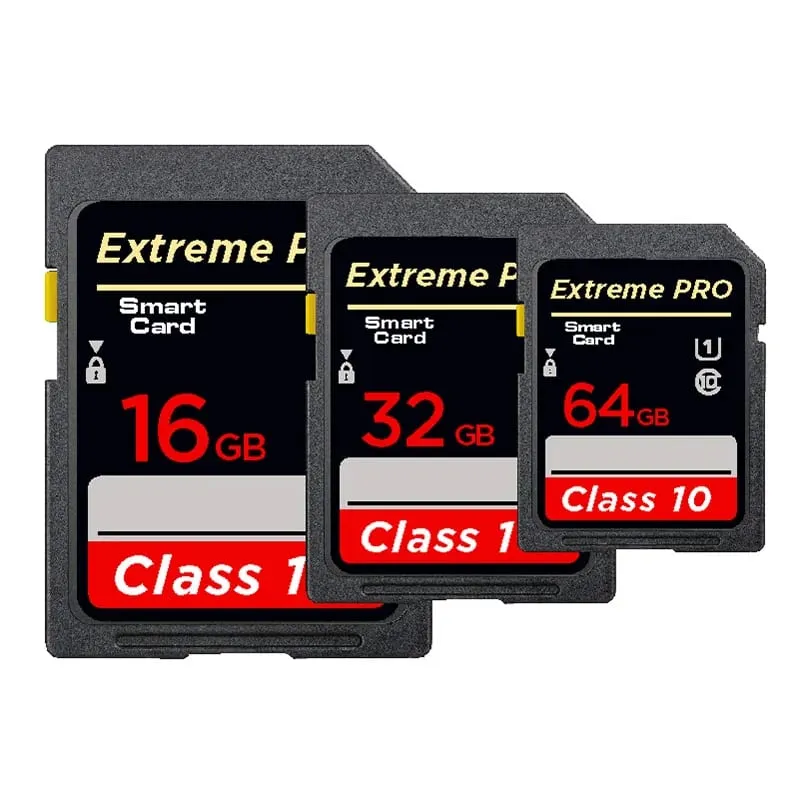
# The Little Memory Card That Keeps Showing Up in My Camera Bag
I've been selling memory cards for years now, and I'll be honest with you — most of them are boring. They work, you forget about them, life goes on. But every so often a batch comes through the shop that makes me stop and actually pay attention, and that's exactly what happened with these SD cards we just stocked under SKU P3256801241425945. They come in every capacity from a humble 8GB all the way up to 256GB, and at $11.99 they've become the card I quietly recommend to just about everyone who walks in asking for something that won't let them down. Let me tell you why.
First, the build. These cards are made from the standard injection-molded plastic shell you'd expect from any SD card, with the usual gold-plated contact pins on the back, but the tolerances are tighter than I expected for the price. No wiggle when you slot them in, no cheap-feeling flex when you press them into a camera. The write-protect switch on the side snaps firmly between positions instead of sliding around loose like it does on some budget cards I've handled. The label printing is clean and doesn't smear if your fingers are sweaty, which sounds like a small thing until you've ruined a card label with sunscreen at the beach. I've dropped a couple on the shop floor, stepped on one by accident, and it still reads fine. That's not a torture test, obviously, but it tells me the shell isn't going to crack the first time it takes a knock in your bag.
Now the specs, because I know some of you want numbers. These are standard full-size SD cards, 32mm by 24mm by 2.1mm — the classic dimensions that fit SLR cameras, card readers, and just about every laptop slot made in the last decade. Capacities run from 4GB up through 8GB, 16GB, 32GB, 64GB, 128GB, and 256GB. The smaller cards (4GB) are Class 6, while everything from 8GB upward is Class 10, with the 64GB and above being SDXC. Read speeds on the Class 10 cards land around the 15–20MB/s mark with write speeds in the 6–8MB/s range when tested through a standard 2.0 USB reader — and before anyone emails me about that, yes, a faster reader will give you better numbers. Color options vary by batch, so check the listing photos for what's currently in stock. They operate fine from -13°F to 185°F, which covers basically any weather you're realistically going to shoot in, and they store safely from -40°F up to 185°F.
So what do people actually use these for? Three scenarios come up constantly in my shop. The first is the family photographer — mom or dad with a Canon or Nikon SLR who fills up a card at every birthday party and vacation, and needs something reliable that won't corrupt three years of memories. The second is the hobbyist who shoots wildlife or kids' soccer games and wants a spare card rattling around in the camera bag so they never miss a shot because they ran out of space. The third, and honestly my favorite, is the person digitizing old photo albums or scanning documents — they plug one of these into a card reader, dump a few thousand scans onto it, and hand it to a relative like a little time capsule. Simple, cheap, works.
Using them couldn't be easier. There's no software to install, no formatting gymnastics required — they come pre-formatted and ready to go, though I always suggest doing a quick format in your camera the first time just to be safe. Slide it into your camera's card slot until it clicks, and you're shooting. To pull files off, pop it into a card reader or your laptop's SD slot. Maintenance is mostly common sense: keep them away from strong magnets, don't yank them out while the camera is still writing, and store them in the little plastic case they ship with rather than loose in a pocket full of keys. If a card ever starts acting sluggish, copy everything off it and reformat. Nine times out of ten that fixes it.
The pros are pretty clear. The price is genuinely hard to beat, the range of capacities means you can buy exactly what you need instead of overpaying for space you'll never fill, and the Class 10 speeds are perfectly adequate for still photography and casual video. The honest cons? These are not cards for 4K video shooters or anyone burst-shooting RAW files at ten frames a second — you'll hit the buffer and get frustrated. The read and write speeds are respectable for the class but they're not going to win any benchmarks. And one thing the supplier is upfront about that I'll repeat here: these are designed for cameras, not mobile phones. If you try to jam one into a phone that takes microSD, it simply won't fit. Check your device first.
Here's my expert take, for what it's worth after handling thousands of these. The design philosophy here is deliberate simplicity — a single-piece molded shell with no moving parts beyond the write-protect tab, contacts positioned exactly where the SD standard says they should be, and controller chips chosen to hit a price point that makes sense for casual shooters rather than professionals. That's not a compromise so much as a targeting decision. This card suits the occasional photographer, the parent documenting childhood, the student with a first DSLR, the traveler who wants a backup card without spending forty dollars. If you're a working professional, buy the expensive cards — you already know that. Everyone else, this is the sensible pick. Grab the 32GB or 64GB for everyday shooting, or the 256GB if you'd rather not think about storage for a whole trip. At $11.99, throwing a spare in your bag costs less than lunch.