I've sold a lot of kitchen gadgets over the years, and most of them follow the same pattern: someone buys them with big plans, uses them twice, and then they end up in the back of a drawer next to a fondue set. So when I tell you this plastic manual potato masher is one of the few sub-$15 tools that actually earns its counter space, I'm not just trying to move inventory. This is a tool I've watched people come back and buy a second one of, usually because their mother-in-law borrowed the first one and never returned it. That's the highest praise a kitchen gadget can get.
Let's talk about what it's made of, because this is where cheap mashers fall apart — literally. The body is food-grade PP plastic, the same family of material used in a lot of commercial kitchen gear. The key word from the supplier is "thickened," and they're not exaggerating. I've squeezed these things in my hand and there's no flex, no creaking, none of that hollow feeling you get from dollar-store versions. That matters because the moment a masher flexes, the seam where the handle meets the head starts to crack, and you're picking plastic shards out of your dinner. Not here. The build is solid enough that you could hand it to an overenthusiastic teenager mashing potatoes for a crowd and it would survive. It's also non-porous, which means it doesn't stain, doesn't absorb onion or garlic smells, and doesn't hold onto residue the way wood or cheap metal with rough welds can.
Now the exact specs, because I know some of you skip straight to this part. This is a single-piece manual masher — SKU P3256812762338814 for anyone writing that down — and it comes in standard sizes, which in practical terms means a head around 9 to 10 centimeters across and a total length in the 25 to 28 centimeter range, so it fits comfortably in most hands and most drawers. Colors vary by what's in stock; it's a utilitarian item, so don't expect a rainbow, but it's neutral enough to live in any kitchen without clashing. At $13.97, this sits right in that sweet spot where it's cheap enough to buy on a whim but well-made enough that you won't be replacing it next season. One piece, no batteries, no cords, no assembly. That's the whole thing.
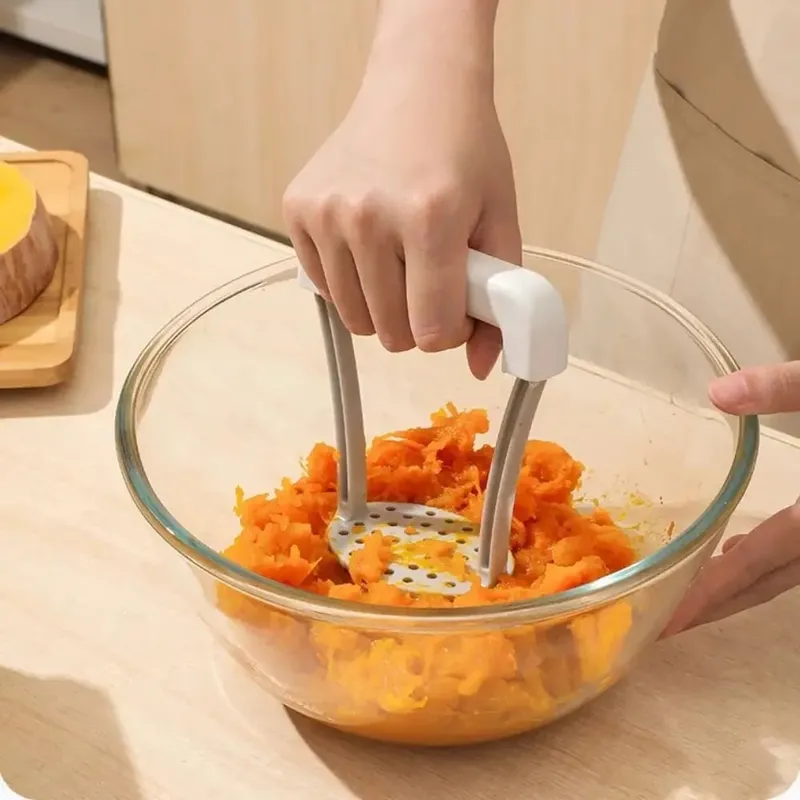
As for what you actually do with it — the name says potato masher, but that undersells it. Obviously, mashed potatoes. But think beyond the holiday table. Scenario one: you're making sweet potatoes for a weeknight dinner and you want them smooth instead of lumpy, and hauling out the stand mixer feels like overkill. This does the job in about ninety seconds. Scenario two: you've roasted a squash or a pumpkin and you want it turned into a puree for soup or baby food. The round holes on the bottom push the flesh through evenly, so you get a consistent texture instead of the shredded mess you get from a fork. Scenario three: root vegetables — parsnips, carrots, turnips, rutabaga. Anything you'd boil and want to break down, this handles it. I've also had customers tell me they use it for mashing beans for refried beans and for breaking up ground meat in a skillet, which honestly never occurred to me but makes total sense.
Using it is about as simple as it gets. Boil or roast whatever you're mashing until it's soft, put it in a bowl, and press down with a rocking or twisting motion. The handle is shaped for one-handed operation, which is a bigger deal than it sounds — you can hold the pot steady with your other hand instead of chasing it around the counter. Maintenance is a thirty-second job: rinse it under warm water right after use, and if something's stubborn, a quick scrub with a sponge and a drop of dish soap does it. The holes are uniform and round, which is the whole trick — nothing gets trapped in them. It's also dishwasher-safe on the top rack, though I'd still give it a rinse first so you're not baking starch onto it. When you're done, it has a hole at the top of the handle so you can hang it on a kitchen hook. No electricity, no counter footprint, no fuss.
Honest pros and cons, because I don't do sales pitch. Pros: it's durable, it's cheap, it cleans up fast, it needs no power, and it works on way more than potatoes. It's light enough to toss in a camp kit or a rental kitchen. Cons: it's plastic, so if you're a person who only cooks with stainless steel for philosophical reasons, this isn't for you. It's not going to give you the ultra-silky puree a food mill or a ricer produces — you'll get a good, even mash with a little texture, not a whipped cloud. And since colors vary by stock, if you have your heart set on a specific color, check before you order. That's it. Those are the drawbacks.
Here's why the design actually works, from someone who's handled thousands of these. A masher's job is to force cooked food through holes without turning it into paste, and that's a balancing act. Too few holes and you're mashing forever. Too many tiny holes and you get glue. This one uses a moderate number of uniform round holes, which gives you even extrusion and a mash that stays fluffy. The thickened PP body means the force you apply goes into the food instead of flexing the tool, and the one-hand grip keeps your wrist in a natural position so you're not fighting it. Who does it suit best? Small households, people in apartments with limited storage, anyone cooking without a full appliance arsenal, campers, and honestly anyone who's tired of dragging out heavy equipment for a job that takes two minutes. If you feed a family of six every night and own a stand mixer, you probably don't need this. Everyone else, it's thirteen bucks well spent.