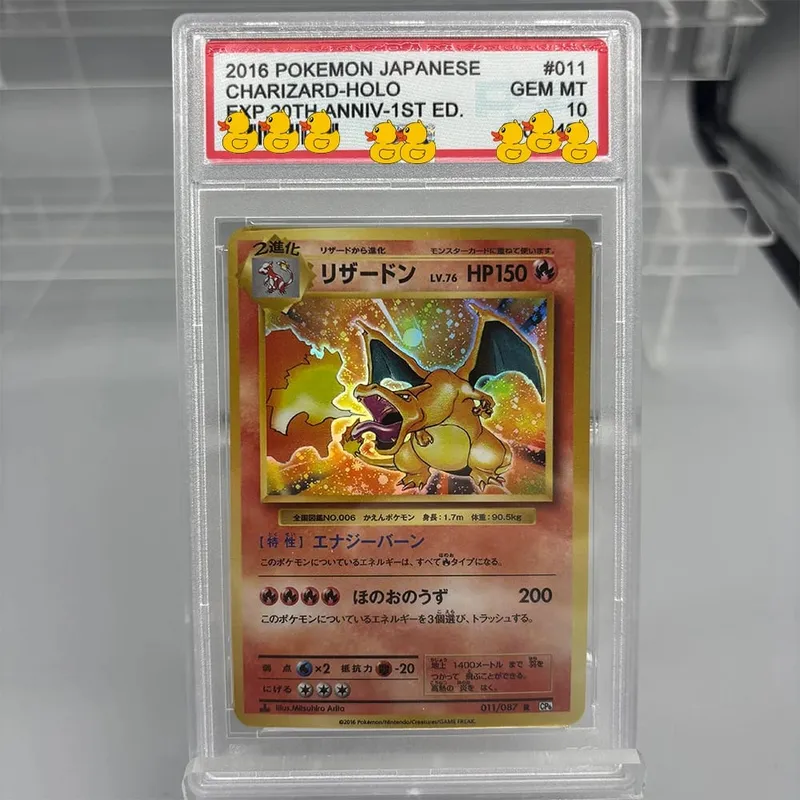
We just got a new batch of these rating cards in, and I've been meaning to write something about them for a while. This is the DIY Rating Card Collection Card — the 2016 EXP.20TH ANNIV 1ST-ED. version, specifically the copy of the Charizard 011/087 with the 10-point rating style. I know that's a mouthful. Let me break it down the way I'd explain it if you were standing at the counter.
First, what is this thing, really? It's a display or collection piece modeled after a graded trading card — the kind of slab you'd see in PSA or Beckett holders. The card inside is a copy, not an original. I want to be upfront about that because it matters. The body is made of a clear, hard acrylic-style plastic that's thick enough to feel substantial in your hand. The card itself sits behind a glossy window with UV-resistant properties they claim will slow fading, though I'd still keep it out of direct sunlight like any collectible. The edges are polished smooth, no rough seams or glue lines, and the label plate is cleanly printed with the anniversary set details. No wobble, no rattle when you shake it. For the price point, the build quality is genuinely good — better than some no-name slabs I've seen that crack if you look at them wrong.
Now the specs. It's a standard grading-slab size — roughly 3.5 by 5.5 inches, so about the footprint of a phone but thicker, maybe half an inch deep. It sits flat or displays upright in a stand (not included, but any standard card stand works). The card is the classic 2.5 by 3.5 inch trading card format, so it fits standard sleeves if you ever want to swap it. Colors available are red, blue, black, gold, and silver — the border trim and label accent change with each. SKU P3256809278823764 covers all color variants, so if you order, double-check which one you want in the dropdown. Weight is light enough to ship cheap, heavy enough to not feel like a toy.
What do people actually do with these? Three real scenarios I see all the time. One: display. Kid or adult, they put it on a shelf, a desk, next to their monitor. It's a conversation piece. Two: gift. This is a birthday or holiday gift for the Pokémon fan who already has everything — the person who has the games, the plushies, the original cards. This is the extra thing they didn't know they wanted. Three: collection filler. If you're building a binder or a display case of anniversary items, this sits in that gap where you don't have an original 1st edition but you want the visual. I've also seen people use it as a photo prop for social media, which, sure, why not.
Using it is simple. Take it out of the box, peel the thin protective film off both sides of the acrylic (there is one, and people miss it constantly), and set it where you want it. To clean, use a microfiber cloth and a tiny bit of water or plastic-safe cleaner. No alcohol, no acetone, no paper towels — those scratch. Don't drop it. It's tough but not indestructible. If you want to swap the internal card, the slab has a small seam you can pry gently with a plastic tool, but honestly, I wouldn't. You risk cracking the edge.
Pros: it looks premium, the 10-point label reads clearly, the acrylic doesn't yellow quickly, and the anniversary branding is crisp. It's a great desk piece for under thirty bucks. Cons, and I'm being honest here: it is a copy, not a real graded card. Some buyers don't read that and get disappointed. Also, the film is annoying to remove if you have short nails. And the stand isn't included, which is a small annoyance. If you're looking for an investment-grade slab, this isn't it. If you want a cool display piece, it is.
Why does this design work? Because it targets a specific emotional gap. Most collectors can't afford a real 1st edition Charizard, and they never will. This gives them the visual satisfaction of a graded slab — the clear case, the label, the sense of "this is official-looking" — without the four-figure price tag. The anniversary branding makes it feel tied to a moment, not just a random card. It suits the casual fan who wants a nice shelf item, the gift-giver who needs a safe bet, and the completionist who wants the look without the cost. It does not suit the serious investor or the person who wants original print. Know which one you are.